The Best Time for Stargazing on Easter Island
When to stargaze on Easter Island: how the new moon, season, and weather affect Rapa Nui's night skies — and how to time your trip for the darkest views.
The single most useful thing to know about stargazing on Easter Island is that when you go matters more than almost anything else. The Rapa Nui stargazing tour can only show you a brilliant sky if two things line up: a clear night and a dark moon. This guide explains how the Moon, the seasons, and the island’s weather interact — and how to time your dates for the best chance of an unforgettable southern sky.
The Moon is the biggest factor
Forget seasons for a moment — the Moon decides more than the calendar does. A bright moon floods the sky with light and erases the faint targets that make Rapa Nui special: the Milky Way’s detail, the Magellanic Clouds, dim nebulae. Skies are darkest around the new moon, and that is exactly when the dedicated stargazing tour is built to run.
In fact the dedicated Rapa Nui stargazing tour typically does not operate in the nights immediately before and after the full moon, when moonlight washes out faint detail. If a dark sky is your priority, plan your travel dates around the lunar calendar before you book flights — aim for the roughly two weeks centred on the new moon.
| Moon phase | Stargazing quality | Notes |
|---|---|---|
| New moon (± a few nights) | Best | Darkest skies; Milky Way and Magellanic Clouds at their richest |
| First / last quarter | Fair | Moon up part of the night; plan around moonset/moonrise |
| Full moon (± a few nights) | Poor | Sky washed out; dedicated tour usually does not run |
Season: a real trade-off
Here is the part many visitors get wrong. It is tempting to assume the cooler “winter” months are clearest, but Easter Island’s climate data tells a more nuanced story — and for stargazing there is a genuine trade-off between clear skies and dark hours.
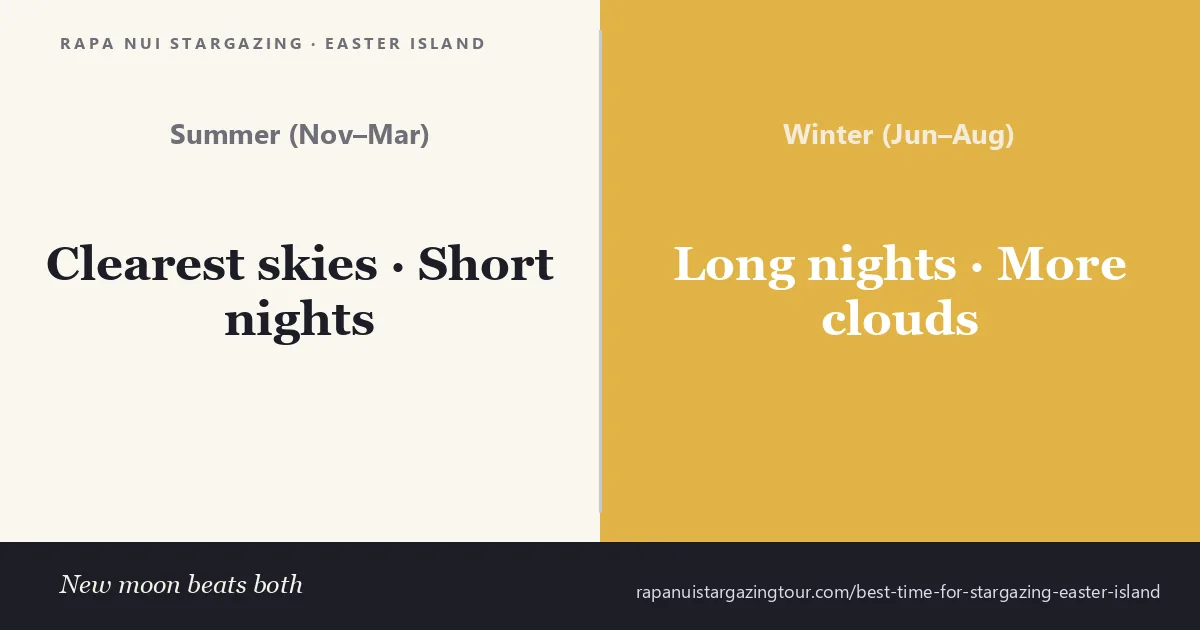
- Cloud cover is generally lowest in the austral summer, roughly November to March, which is the sunniest, driest stretch — January tends to have the brightest skies.
- April and May are the wettest months, and the winter stretch of June to August brings heavier rain and the least daily sunshine (around five hours a day).
- But summer also has short nights and late sunsets — full darkness doesn’t arrive until well after 9 pm, which is why the tour starts at 21:00 in summer versus 19:00 in winter.
So the choice looks like this:
| Period | Cloud / weather | Darkness window | Best for |
|---|---|---|---|
| Summer (≈Nov–Mar) | Driest, sunniest, best clear-sky odds | Short nights, late sunset (tour ≈21:00) | Best chance of a cloudless sky |
| Shoulder (Apr–May) | Wettest months on average | Lengthening nights | Generally avoid for reliability |
| Winter (≈Jun–Aug) | More rain, fewest sunshine hours | Long, dark, early nights (tour ≈19:00) | Long dark hours if the weather cooperates |
The practical takeaway: for the best odds of an actually clear sky, the drier summer months win, even though the nights are shorter. Whatever season you choose, the Moon still matters more — a cloudless full-moon night is worse for deep-sky viewing than a slightly hazy new-moon one.
Build in a spare night
Weather is the one thing no operator can guarantee, and a remote mid-Pacific island makes its own clouds. The safest plan is simple: give yourself more than one possible night. If you only have a single evening and it clouds over, there’s no fallback. Travellers who allow two or three candidate nights around the new moon dramatically improve their chances — and the tour’s free cancellation up to 24 hours before makes it easy to shift.
Putting it together
The ideal stargazing window on Rapa Nui is a clear, moonless night. In order of importance:
- Target the new moon — this is non-negotiable for deep-sky views, and the tour is scheduled around it.
- Favour the drier summer months (≈Nov–Mar) for the best clear-sky odds, accepting shorter nights.
- Allow a spare night in case of cloud.
- Book flexibly — free cancellation up to 24 hours before lets you adapt to the forecast.
Even outside the ideal window, Rapa Nui’s near-zero light pollution means an average night here still beats most skies travellers have ever seen. For a sense of what the evening itself is like, read what to expect on the Rapa Nui stargazing tour.
Ready to Book?
Time it for the new moon, allow a spare night, and the Rapa Nui stargazing tour can deliver one of the darkest skies on Earth — telescopes, local guides, and the Milky Way over the moai. From $140 per person with free cancellation up to 24 hours before. Check availability and book →
See the Southern Sky from the Most Remote Island on Earth
Join a small-group Rapa Nui stargazing tour — telescopes, local guides, and Polynesian wayfinding lore under near-zero light pollution. Free cancellation up to 24 hours before.
Check Availability & Book