How to Get to Easter Island (Rapa Nui)
How to get to Easter Island: the only flights (LATAM from Santiago), flight time, the Rapa Nui National Park ticket, getting around, and how to plan a stargazing trip.
Easter Island is one of the most remote inhabited places on Earth, and getting there is simpler than its isolation suggests — there is essentially one route in. This guide covers the flights, the national park ticket, getting around once you land, and how to fold a Rapa Nui stargazing tour into the trip.
There’s only one way in: fly from Santiago
There are no ferries to Easter Island. The only practical way to arrive is by air, and LATAM is the sole airline flying the route, nonstop from Santiago, Chile (airport code SCL) to Mataveri International Airport (IPC) on Rapa Nui.
| Detail | Value |
|---|---|
| Airline | LATAM (only carrier) |
| Route | Santiago (SCL) → Easter Island (IPC) |
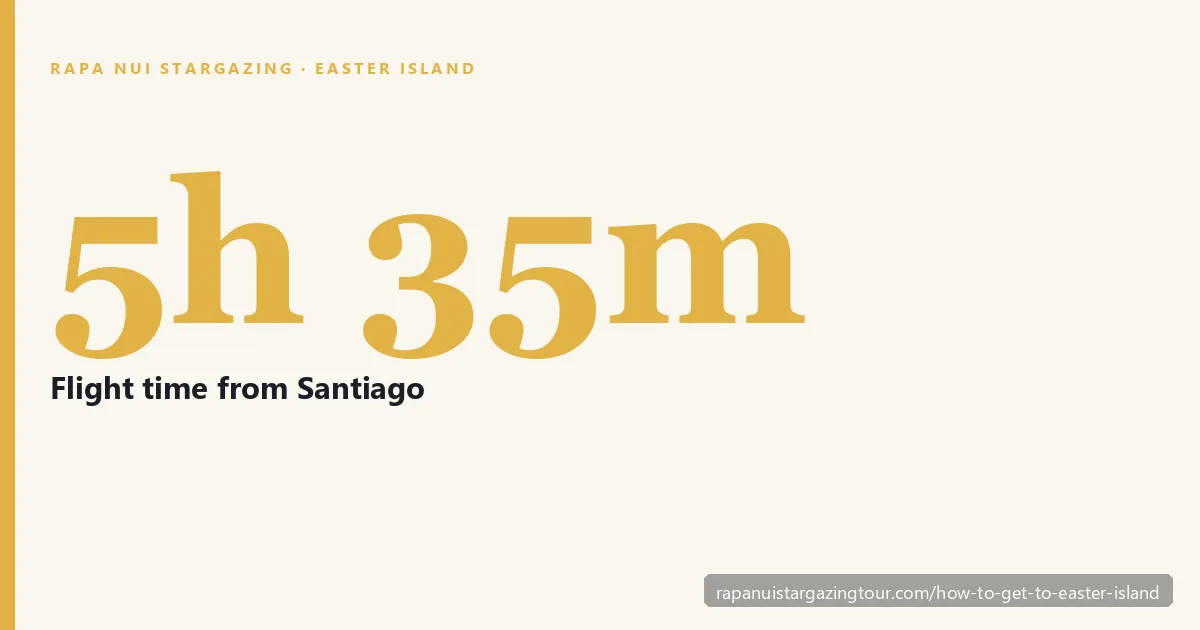
| Flight time | ≈5 hours 35 minutes |
| Frequency | Around 12 flights per week (roughly daily) |
| Distance | ≈3,700 km of open Pacific |
Most international travellers fly into Santiago first, overnight in the city, and continue to Rapa Nui the next day. Because LATAM is the only operator and the aircraft are limited, book the SCL–IPC leg well ahead, especially around the new moon if you’re timing the trip for stargazing.
The Rapa Nui National Park ticket
Almost the entire island is protected as Rapa Nui National Park, a UNESCO World Heritage Site, and you’ll need a park ticket to visit the major archaeological sites — Rano Raraku, Orongo, Ahu Tongariki, Anakena and more.
- The entrance ticket is US$80 for foreign adult visitors (as of 2026-06-21).
- It is valid for 10 days from your first site visit.
- It is sold online through the national park’s official channel — buy it before you arrive.
- Note the access rules: Rano Raraku and Orongo may each be entered only once on the ticket, while other sites have no visit limit.
Beyond the ticket, several sites legally require you to be accompanied by an authorised local guide, which is one reason booking guided tours is both the easiest and the most respectful way to explore. (Prices and rules can change — confirm the current fee on the official park site when you buy.)
Getting around the island
Easter Island is compact — roughly 24 km at its longest — but the sites are spread out and public transport is minimal. Your options:
- Guided tours — the simplest way to reach the moai sites, and required at some of them. Daytime sightseeing tours of the main ahu start from around $70 per person.
- Rental vehicle — possible, but roads are unpaved in places and unlit after dark, which makes night driving to a stargazing site genuinely hazardous.
- Walking / cycling — fine around Hanga Roa, the only town, but impractical for the far sites.
This is exactly why the stargazing tour includes pickup and hotel drop-off: you don’t want to be navigating dark, unlit roads yourself to find an observation spot.
Where to stay
Hanga Roa is the island’s only town and where essentially all accommodation, restaurants and tour meeting points are. The featured stargazing tour meets at the Katipare Library (Centro Lector Katipare) in Hanga Roa, so staying in or near town keeps everything within easy reach.
A few things to know before you fly
Easter Island is a special territory of Chile, so a few practicalities follow from that and from its sheer remoteness:
- Language and currency. Spanish is the main language alongside the Rapanui language, and the currency is the Chilean peso. Many tours and the stargazing experience here are quoted and bookable in US dollars, but day-to-day spending in town is in pesos.
- Bring some cash. On an island this isolated, card acceptance and ATMs are limited and can be unreliable — carrying cash avoids being caught out, especially for small purchases and tips.
- Goods cost more. Almost everything is shipped or flown in, so food, fuel and supplies are pricier than on the mainland. Budget accordingly and pack essentials (medications, specific toiletries, spare camera batteries) rather than relying on finding them locally.
- Time and pace. With one town and a handful of flights a week, the island runs at an unhurried pace. Plan a minimum of two to three full days to see the main moai sites and still have a clear, moonless night spare for stargazing.
None of this is a barrier — it’s simply the texture of visiting one of the most remote inhabited places on Earth. A little preparation means the only thing you’re thinking about on tour night is the sky.
Planning a stargazing trip — the order of operations
If the night sky is the reason you’re going, plan in this order:
- Pick your dates around the new moon — the darkest skies, and when the stargazing tour runs. See the best time for stargazing on Easter Island.
- Book the LATAM SCL–IPC flights early — limited capacity, one airline.
- Buy your Rapa Nui National Park ticket online before arrival.
- Reserve tours, including the stargazing evening and a daytime moai tour or two — they pair perfectly.
- Allow a spare night for the stargazing session in case of cloud; free cancellation up to 24 hours before makes this easy.
Come for the moai, stay for the stars — Easter Island rewards both halves of the trip.
Ready to Book?
Once your flights and park ticket are sorted, the Rapa Nui stargazing tour is the one experience built around the island’s extraordinary dark skies — small-group, local guides, telescopes, and hotel pickup so you never drive the dark roads yourself. From $140 per person, free cancellation up to 24 hours before. Check availability and book →
See the Southern Sky from the Most Remote Island on Earth
Join a small-group Rapa Nui stargazing tour — telescopes, local guides, and Polynesian wayfinding lore under near-zero light pollution. Free cancellation up to 24 hours before.
Check Availability & Book